Script API reference
Every Script runs in a browser document with a constrained definer API. The API is also available as window.definer, but normal scripts can use the shorter definer name directly.
The runtime executes your code inside an async function. Top-level await, return, try/catch, and ordinary JavaScript declarations therefore work without an extra wrapper.
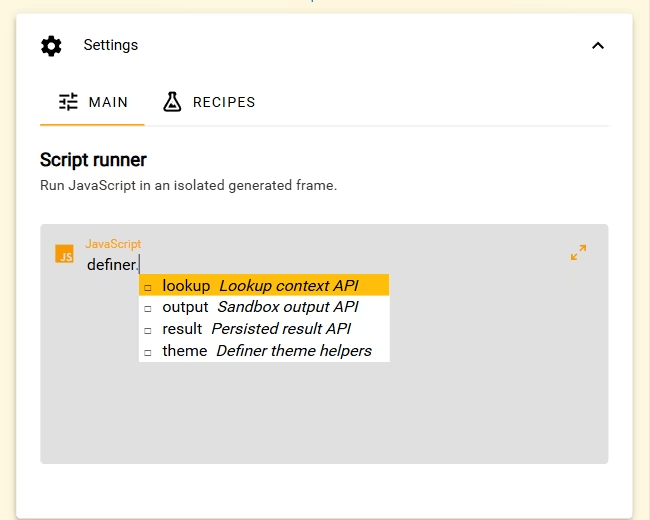
API at a glance
| Namespace | Purpose |
|---|---|
definer.lookup | Read the current lookup context and request another result language. |
definer.result | Read and update the plain JSON object persisted with this result. |
definer.output | Replace the result body's HTML or the helper-managed CSS. |
definer.theme | Read the active theme and create Definer CSS-variable references. |
The API intentionally does not expose extension privileges, internal messaging, global settings, or arbitrary lookup-session mutation.
Lookup
definer.lookup.query
Type: string (read-only)
The current lookup text. This is the same query represented by the surrounding lookup session.
definer.lookup.language
Type: string (read-only)
The language of this Script result. Calling activateLanguage() does not mutate this value in place: an accepted language change causes Definer to activate that language and recreate the result frame.
definer.lookup.source
Type: { id, type, index?, options } | null (read-only cloned value)
A copy of the current Source information available to the Script. options.code is omitted. Changing the returned object does not change the Source.
definer.lookup.getVariable(name)
Signature: getVariable(name: string): any
Returns an isolated snapshot of one lookup variable. Objects and arrays are cloned; changing the returned value does not change the lookup. An unknown or unavailable name returns undefined.
Use literal names whenever possible so the value remains available when you reopen a saved lookup:
const pageText = definer.lookup.getVariable('page_text')
const context = {
	query: definer.lookup.query,
	language: definer.lookup.language,
	url: definer.lookup.getVariable('url') ?? null,
	pageTitle: definer.lookup.getVariable('page_title') ?? null,
	sentence: definer.lookup.getVariable('sentence') ?? null,
	paragraph: definer.lookup.getVariable('paragraph') ?? null,
	pageTextPreview:
		typeof pageText === 'string' ? pageText.slice(0, 500) : null,
}

definer.output.setHtml(`
	<section class="context-inspector">
		<h1>Lookup context</h1>
		<pre></pre>
	</section>
`)
definer.output.setCss(`
	.context-inspector { padding: 16px; }
	.context-inspector h1 { margin-top: 0; }
	.context-inspector pre {
		padding: 12px;
		overflow: auto;
		white-space: pre-wrap;
		border-radius: 8px;
		background: ${definer.theme.rgba('text', 0.06)};
	}
`)

document.querySelector('.context-inspector pre').textContent = JSON.stringify(
	context,
	null,
	2,
)
The Lookup variable reference lists every name, type, and example. See Use Lookup variables in Script for literal and computed name rules.
definer.lookup.activateLanguage(language)
Signature: activateLanguage(language: string): void
Asks the surrounding lookup to activate an available result language. The code must be non-empty and already present in the lookup's language picker.
The current run keeps its old definer.lookup.language. When Definer accepts the change, it activates the language and reruns the Script result. An empty or unavailable code is shown as a Script error.
See the tested Multilingual Wikipedia Summary for a complete example that uses the configured result languages for a real data source.
Result data
Result data is the only Script-owned state that survives the document. It belongs to the specific source and result language in that lookup; it is not a global settings store.
definer.result.getData()
Signature: getData(): Record<string, any>
Returns an isolated clone of the current result data. Mutating the returned object has no effect until it is passed to setData() or patchData().
Within one run, getData() immediately reflects successful setData() and patchData() calls.
definer.result.setData(data)
Signature: setData(data: Record<string, any>): void
Replaces the entire data object. The new value is available immediately to getData(). Invalid input throws a TypeError, so the Script can catch and handle it; otherwise Definer shows the error in the result.
definer.result.patchData(data)
Signature: patchData(data: Record<string, any>): void
Shallow-merges the supplied object's top-level properties into the current data object. Nested objects are replaced, not recursively merged. Validation happens before the merge, and invalid input throws a synchronous TypeError.
Accepted Values
The root must be a plain object and every nested value must be representable as strict JSON:
- accepted: strings, booleans, finite numbers,
null, arrays, plain objects, and objects such asDatethat deliberately serialize to valid JSON; - rejected:
undefined, functions, symbols,BigInt,NaN, infinities, circular references, and non-object roots.
Other object types follow their ordinary JSON behavior. For example, Date becomes a string, while many runtime objects serialize to {} or lose most of their information. Do not store DOM nodes, maps, sets, errors, class instances, or similar runtime objects: they do not round-trip meaningfully.
Definer clones data during every read and write. Keep only the values the result needs, and use the normal error handling above for data that does not meet the JSON rules.
The Lookup Notes example demonstrates the full restore-render-update cycle with useful per-result data:
const saved = definer.result.getData()

definer.output.setHtml(`
	<section class="lookup-notes">
		<label for="lookup-note">Notes for this lookup</label>
		<textarea id="lookup-note" rows="6" placeholder="Add a mnemonic, example, or reminder…"></textarea>
		<div>
			<button type="button">Save note</button>
			<span role="status"></span>
		</div>
	</section>
`)
definer.output.setCss(`
	.lookup-notes { display: grid; gap: 10px; padding: 18px; }
	.lookup-notes label { font-weight: 600; }
	.lookup-notes textarea {
		width: 100%; padding: 10px; resize: vertical; color: inherit;
		border: 1px solid ${definer.theme.rgba('text', 0.2)};
		border-radius: 8px; background: ${definer.theme.rgba('text', 0.04)};
	}
	.lookup-notes div { display: flex; align-items: center; gap: 10px; }
	.lookup-notes button { padding: 7px 12px; cursor: pointer; }
	.lookup-notes [role="status"] { opacity: 0.7; }
`)

const note = document.querySelector('.lookup-notes textarea')
const status = document.querySelector('.lookup-notes [role="status"]')
note.value = typeof saved.note === 'string' ? saved.note : ''

document.querySelector('.lookup-notes button').addEventListener('click', () => {
	definer.result.patchData({
		note: note.value,
		updatedAt: new Date().toISOString(),
	})
	status.textContent = 'Saved with this lookup.'
})
Output
Output helpers are optional. The sandbox document's normal document and DOM APIs remain available.
definer.output.setHtml(html)
Signature: setHtml(html: string): void
Replaces document.body.innerHTML. A later call replaces the previous body contents, including nodes and listeners attached to those nodes.
setHtml() performs no sanitization. Treat queries, lookup variables, fetched content, and saved data as untrusted. Prefer creating elements and assigning dynamic values through textContent; use innerHTML only for markup you trust or have sanitized yourself.
definer.output.setCss(css)
Signature: setCss(css: string): void
Replaces the contents of one style element managed by the Script runtime. A later call replaces the earlier helper-managed CSS. Styles inserted independently through the DOM remain your responsibility.
Direct DOM access
You may use document.createElement(), selectors, events, form controls, canvas, and other DOM APIs directly. The result document remains under your control while it is open. Normal form submission is not available.
Default document styles
Before user CSS, Definer applies a small theme-aware baseline: light/dark color-scheme, the ground page background, zero body margin, theme text/font properties, border-box sizing, and the anchor color for links. setCss() can override these defaults for the result, while the active theme variables remain available on the document root.
Theme
Definer applies the active theme's CSS variables to the Script document and supplies helpers for referring to them.
Properties
| Property | Type | Meaning |
|---|---|---|
definer.theme.id | string | null | Current theme identifier. |
definer.theme.variables | Record<string, string> | Isolated snapshot of all supplied CSS variables, keyed by names such as --v-text-base. |
Methods
| Method | Returns | Behavior |
|---|---|---|
get(name: string) | string | Resolves an exact CSS-variable name or a short color name such as text; returns '' when missing. |
cssVar(name: string, fallback?: string) | string | Creates var(--v-<name>-base) or a reference to an exact --... name. |
rgba(name: string, alpha?: number) | string | Creates an rgba(var(--<name>-rgb), alpha) reference; the default is 1 and alpha is clamped to 0–1. |
mix(name: string, amount?: number, other?: string) | string | Creates a color-mix() expression; defaults are 80 and text, and amount is clamped to 0–100. |
apply(element?: HTMLElement, variables?: Record<string, string>) | void | Applies valid --... variables inline. Defaults to the document root and the current theme snapshot. |
Short color names map to Definer variables. For example, text maps to --v-text-base, primary maps to --v-primary-base, and primary.lighten1 maps to --v-primary-lighten1. Passing an exact name beginning with -- leaves that name intact.
Standard Definer color names are primary, secondary, accent, ground, text, ptext, contrast, anchor, error, warning, info, and success. A theme can expose additional variables; inspect definer.theme.variables when integrating a custom one.
Theme updates are applied to the live document without rerunning the script. CSS created with cssVar(), rgba(), or mix() continues to follow the updated variables. A raw value returned by get() and copied elsewhere is a snapshot.
apply() also writes snapshot values inline. Calling it with no arguments copies the entire current theme onto document.documentElement; those inline declarations can override later values applied by Definer's live theme style block. Prefer CSS references for live theming, or use apply(element, variables) only for deliberate custom inline variables.
The Page Citation and other catalog scripts use theme helpers in useful result interfaces. For example, Page Citation uses rgba() to derive a subtle theme-aware surface:
const title = definer.lookup.getVariable('page_title') || 'Untitled page'
const url = definer.lookup.getVariable('url') || 'URL unavailable'
const site = definer.lookup.getVariable('page_og_site_name')
const modified = definer.lookup.getVariable('page_last_modified')
const accessed = new Intl.DateTimeFormat('en', { dateStyle: 'medium' }).format(new Date())
const source = site ? `${title}. ${site}.` : `${title}.`
const detail = modified ? `Last modified ${modified}.` : `Accessed ${accessed}.`
const formats = {
	plain: `${source} ${detail} ${url}`,
	markdown: `[${title.replaceAll('[', '\\[').replaceAll(']', '\\]')}](${url})`,
}

definer.output.setHtml(`
	<section class="citation-builder">
		<div>
			<button type="button" data-format="plain">Plain text</button>
			<button type="button" data-format="markdown">Markdown</button>
		</div>
		<pre></pre>
	</section>
`)
definer.output.setCss(`
	.citation-builder { padding: 18px; }
	.citation-builder div { display: flex; gap: 8px; }
	.citation-builder button { padding: 7px 12px; cursor: pointer; }
	.citation-builder pre {
		padding: 12px; white-space: pre-wrap; user-select: text;
		border-radius: 8px; background: ${definer.theme.rgba('text', 0.06)};
	}
`)

const output = document.querySelector('.citation-builder pre')
const showFormat = (format) => {
	output.textContent = formats[format]
}

for (const button of document.querySelectorAll('.citation-builder button')) {
	button.addEventListener('click', () => showFormat(button.dataset.format))
}

showFormat('plain')
Standard browser APIs
The isolated document supports ordinary APIs provided by the current browser, including:
window,document, DOM events, form controls, canvas, and media elements;- promises, top-level
await, timers,queueMicrotask, andrequestAnimationFrame; URL,TextEncoder,TextDecoder,ReadableStream,AbortController, and other web-platform primitives;- Script Fetch for HTTP and HTTPS requests.
Availability still follows normal browser and sandbox rules. Feature-detect optional APIs when a script depends on them.
Error behavior
Syntax errors, exceptions, rejected top-level execution, uncaught global errors, and unhandled promise rejections are reported in the Script result. Correct the problem, then select Retry or run the lookup again.
Errors caught by your own code are yours to render or recover from. Remote-data scripts should normally show explicit loading, empty, and failure states rather than leaving the result blank.